

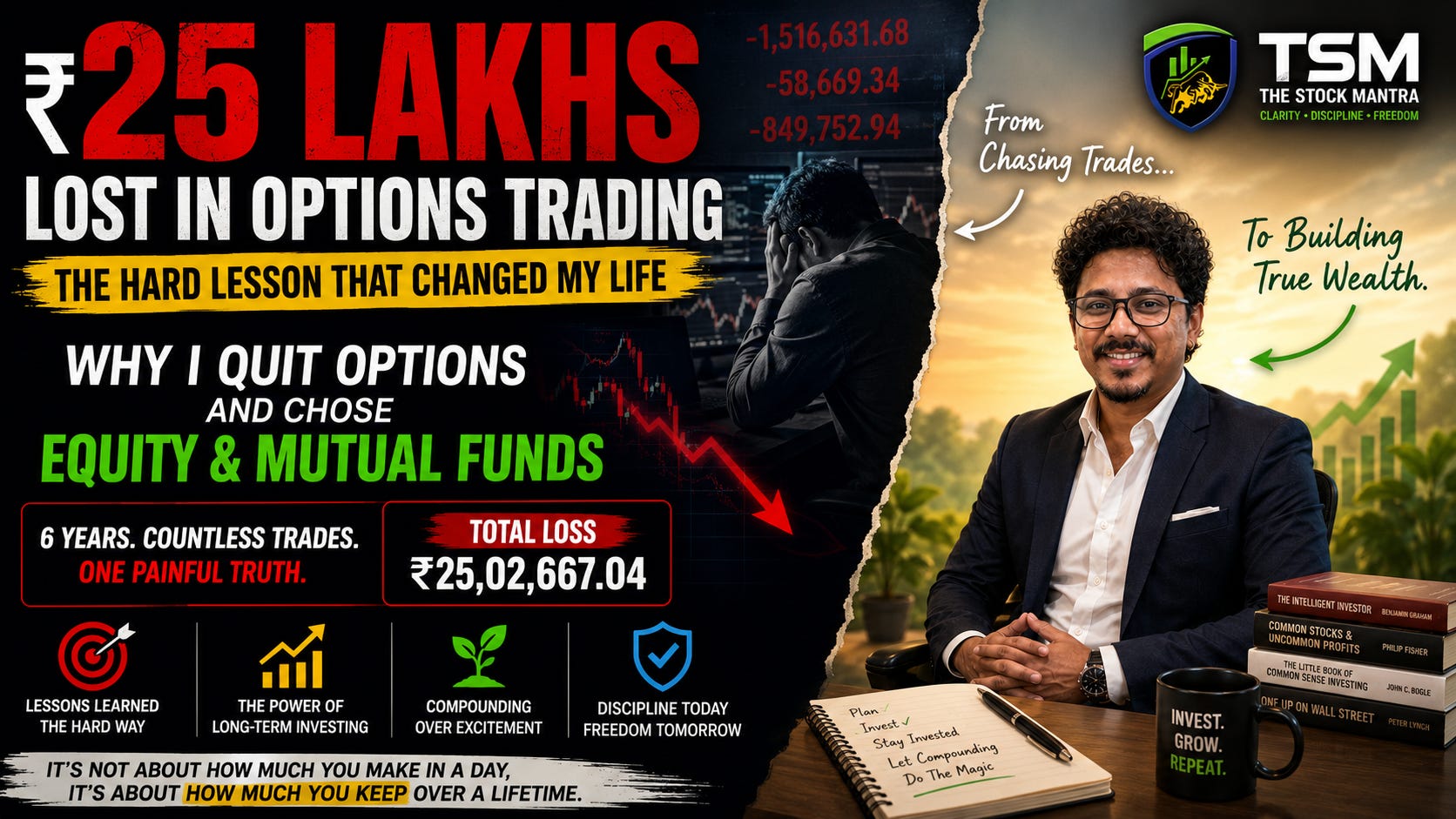
There are some numbers you never forget.
For me, one of those numbers is:
₹25,02,667.04
That isn’t my investment portfolio.
It isn’t my profit.
It isn’t my turnover.
It’s the amount I lost trading options over the past six years.
Writing this publicly isn’t easy.
No one enjoys talking about failure—especially financial failure.
Social media celebrates people who post screenshots of profits.
Very few people openly discuss years of losses, broken confidence, sleepless nights, and the emotional toll that comes with chasing quick money.
But I believe this story deserves to be told.
Because if my mistakes can help even one person avoid walking down the same path, then those losses will have taught me something valuable.
The Dream That Almost Became an Obsession
Like many retail traders, I entered the stock market with a simple dream.
Financial freedom.
The idea of earning money from anywhere with just a laptop sounded exciting.
Options trading appeared to offer something irresistible:
Small capital.
Large returns.
Quick results.
Everywhere I looked, there were stories of people making lakhs in a single day.
Charts.
Indicators.
Signals.
Strategies.
It all looked achievable.
What I didn’t see were the thousands of traders quietly losing money behind the scenes.
I believed success was only one strategy away.
I was wrong.
The Cost of Chasing Fast Money
Over the years, my trading journey became a cycle.
Study.
Trade.
Lose.
Improve.
Trade again.
Lose again.
Repeat.
Every loss convinced me that I was “close.”
I thought:
“If I learn one more setup...”
“If I improve my psychology...”
“If I become more disciplined...”
Everything will change.
While I certainly became a better student of the markets, one uncomfortable reality remained:
Options trading is an incredibly difficult game.
Even experienced professionals face losing streaks.
Markets change.
Volatility changes.
Liquidity changes.
And sometimes, even a well-planned trade simply doesn’t work.
The Hidden Cost Nobody Talks About
Money wasn’t the only thing I lost.
Options trading also demanded something far more valuable.
Time.
Mental peace.
Confidence.
Relationships.
When you’re constantly watching every candle, every news event, every overnight gap, your mind never truly rests.
The market closes.
Your thoughts don’t.
Even on weekends, you’re thinking about Monday.
Eventually, I realized something profound:
The market wasn’t controlling my capital anymore.
It was controlling my attention.
And attention is one of our most valuable assets.
The Difference Between Excitement and Wealth Creation
One day, I asked myself a difficult question.
“What is my actual goal?”
Was it to become an options trader?
Or was it to build long-term wealth?
Those are two very different objectives.
Many people confuse activity with progress.
Making ten trades a day feels productive.
Checking portfolios every fifteen minutes feels responsible.
But neither necessarily creates wealth.
Sometimes, doing less creates more.
Analogy #1: Building a House vs Playing the Lottery
Imagine two people.
One spends years building a house brick by brick.
The other buys lottery tickets every week hoping to become rich overnight.
The lottery offers excitement.
The house offers stability.
Options trading often feels like the lottery.
Investing feels like building the house.
One depends heavily on outcomes.
The other depends on consistency.
The Moment Everything Changed
After reviewing six years of records, I finally faced reality.
My cumulative options trading losses had crossed ₹25 lakh.
That wasn’t just a number.
It represented:
Thousands of hours
Hundreds of decisions
Countless emotional highs and lows
I could have continued.
Many traders do.
After all, the market always whispers:
“One more trade.”
“This time will be different.”
But I realised something important.
Sometimes, the bravest decision isn’t placing another trade.
It’s choosing to stop.
Why I Chose Equity Investing Instead
Unlike options, equity investing gives businesses time to grow.
When you invest in quality companies, you’re not merely buying a ticker symbol.
You’re becoming a part-owner of a business.
Businesses innovate.
They generate profits.
They create products.
They compound value over time.
Markets may fluctuate daily.
Strong businesses often continue growing for years.
That difference changed my perspective completely.
And Why Mutual Funds Became Part of My Plan
Not everyone has the time or expertise to analyse companies regularly.
That’s perfectly okay.
Mutual funds provide professional management, diversification, and disciplined investing.
They may not promise overnight riches.
But they offer something far more valuable:
A structured path toward long-term wealth creation.
Sometimes the smartest investment decision isn’t finding the next multibagger.
It’s building the habit of investing consistently.
Analogy #2: Planting a Banyan Tree
A banyan tree doesn’t become enormous overnight.
You plant it.
You nurture it.
You protect it.
Years later, it provides shade for generations.
Investing works the same way.
Compounding rewards patience—not impatience.
The people who benefit the most are often those willing to wait.
My New Philosophy
Today, my relationship with the market is completely different.
I’m no longer chasing excitement.
I’m chasing sustainability.
My focus has shifted from:
Daily profits → Lifetime wealth
Prediction → Preparation
Speed → Consistency
Speculation → Ownership
This doesn’t mean trading is “bad.”
There are disciplined professionals who succeed in trading through years of experience, robust risk management, and clearly defined processes.
But I also learned an important truth:
Every financial journey should match the individual’s personality, goals, and temperament.
Mine didn’t.
And accepting that was liberating.
The Biggest Lesson ₹25 Lakhs Taught Me
If I had to summarise six years into one sentence, it would be this:
The stock market is not a place to prove intelligence. It is a place to build wealth.
Wealth doesn’t always come from doing more.
Sometimes it comes from avoiding unnecessary risks.
From respecting compounding.
From staying invested.
From allowing time to work in your favour.
Looking back, I don’t see those six years only as losses.
I see them as expensive tuition fees.
Painful?
Yes.
Valuable?
Absolutely.
Because they taught me lessons no textbook ever could.
Final Thought
If you’re currently chasing losses, constantly switching strategies, or feeling emotionally exhausted by the market, pause for a moment.
Ask yourself:
“What am I truly trying to achieve?”
If the answer is financial freedom...
Remember that financial freedom is rarely built through constant excitement.
More often, it’s built through discipline, patience, and a long-term mindset.
Sometimes the greatest investment you’ll ever make isn’t in a stock.
It’s in changing your approach.
✍️ Sign-off
To clarity over confusion,
Soubhagya Sahoo
Founder, The Stock Mantra
🔔 PS
If you’re serious about building financial freedom through the art of trading and investing, you don’t have to walk the journey alone.
Join our growing TSM Hub community:
👉 https://telegram.me/thestockmantra
Together, we learn, grow, and support each other with one common goal—building lasting wealth through knowledge, discipline, and informed decision-making.
⚖️ Disclaimer
This article reflects my personal journey and experience and is shared solely for educational and informational purposes. It should not be interpreted as investment, trading, or financial advice, nor should it be construed as suggesting that any particular asset class or strategy is suitable for everyone.
Every investor and trader has different financial goals, risk tolerance, experience, and circumstances. Please conduct your own research and consult a SEBI-registered Investment Adviser or Research Analyst before making any investment decisions. Investments in the securities market are subject to market risks, and past performance does not guarantee future results.