

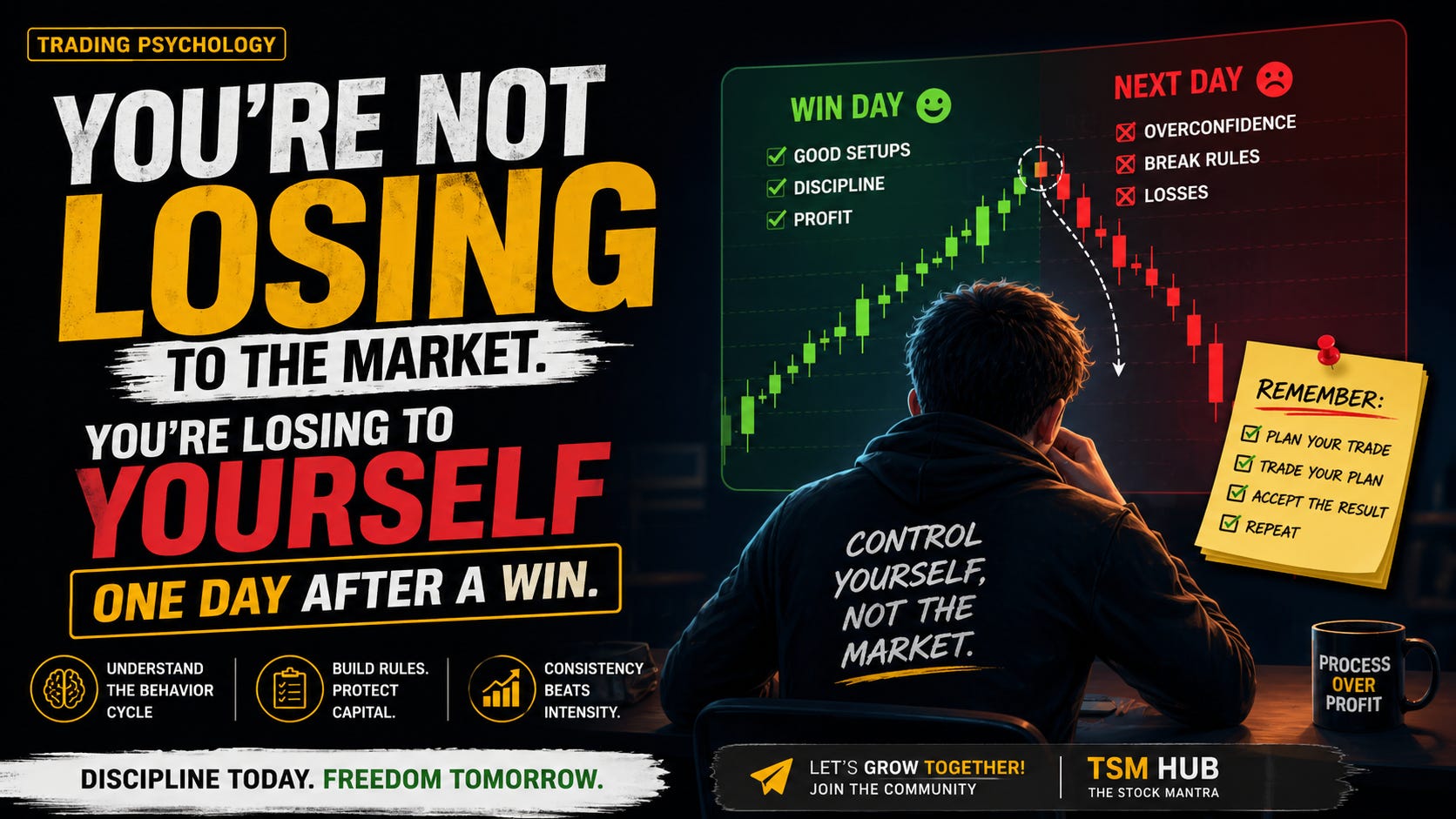
Picture this. You’ve just had a fantastic trading day. Clean entries, disciplined exits, money in the account. You lean back, maybe crack a rare smile, and think the six most dangerous words in trading:
“I think I’ve figured this out.”
The next morning, you open your charts wearing that same confidence — only now it has a slight edge to it. Not reckless. Just… loose. By afternoon, a chunk of yesterday’s profits is gone, and you’re staring at your screen wondering if the market just personally targeted you.
It didn’t. You changed. And that’s the conversation nobody is having loudly enough.
The Real Game Isn’t on the Chart
Most traders obsess over entries, exits, indicators, and strategies. And sure, those matter. But the actual game — the one that separates consistently profitable traders from the vast, frustrated majority — is played across multiple days, not within a single trade.
One good trade proves nothing. One bad trade proves nothing. But your pattern of behavior across days? That reveals everything about whether you’ll survive this market long enough to thrive in it.
The Silent Cycle (You Might Be Living This Right Now)
Here’s how the loop tends to go, with uncomfortable accuracy:
Good day — You follow your rules, take clean setups, and bank profits.
Confidence spike — “Maybe I can scale this. I’m understanding the market.”
Next-day shift — Rules relax. Size increases slightly. Decisions come faster.
Loss day — Overtrading, emotional entries, the dreaded “one more trade” spiral.
Recovery attempt — You fight the market to get even. Sometimes you win. Sometimes you make it worse.
Then the whole thing restarts. This isn’t bad luck. It’s a psychological pattern — and understanding it is the beginning of breaking it.
Why Your Brain Is Working Against You
Here’s the uncomfortable truth: your brain doesn’t understand probability. It understands reward, pain, and memory. After a winning day, it files away “confidence + reward” and quietly dials down caution for the next session. After a losing day, it stores “pain + urgency” and cranks up aggression to compensate.
The result? You stop trading the market. You start trading your last result. That’s a fundamentally different — and far more dangerous — game.
Analogy 1 — The Unlimited Buffet
Imagine you’re at an all-you-can-eat buffet. First plate: perfectly balanced, thoughtful, controlled. You feel good about yourself.
Second plate: “Just a little more of that pasta...”
Third plate: “Well, it’s unlimited anyway...”
Fourth plate: regret, discomfort, and a firm promise to “do better next time.”
Trading works exactly the same way. After a few good trades, the market starts to feel unlimited. You start consuming risk well past what your system allows. And just like the buffet, the consequences aren’t immediate — they arrive with interest.
The Problem Isn’t the Loss
Loss is a built-in feature of trading. Every professional trader accepts this. The real problem is something subtler and far more destructive:
Your reaction to profit and loss is wildly inconsistent — and that inconsistency is costing you more than any bad setup ever could.
Analogy 2 — The Open Highway
You’re driving on an empty road. You’re at a safe, responsible speed. Road is clear. Nothing bad is happening. So naturally, you push it a little.
Still fine. So you push more.
And then one small obstacle — a pothole, a stray dog, a sudden turn — becomes a catastrophe at that speed.
The open road didn’t change. Your speed changed. And by the time something went wrong, there wasn’t enough margin to recover gracefully.
Trading at elevated confidence is exactly this. The market is the road. You are the driver. And “nothing went wrong yet” is not a safety metric.
What Actually Works: A Simple Framework
After a strong profit day
Reduce your size the next day. Trade less. Seriously consider not trading at all. Your brain is in overconfidence mode — and overconfidence mode doesn’t feel like overconfidence. It feels like clarity. That’s what makes it dangerous.
After a loss day
Do not try to recover immediately. The market will still be there tomorrow. Trade smaller, focus entirely on execution quality rather than P&L, and let the emotional static dissipate before you size back up.
Set your daily limits before the market opens
Decide in advance: maximum number of trades, maximum loss for the day, and a profit level where you simply stop. Once any of those limits are hit, the session is over. No negotiations, no exceptions.

Why Most Traders Stay Stuck
Because they look for the solution in the wrong place. More indicators. Better setups. Different timeframes. More YouTube videos at 11pm. None of that addresses the actual problem, which is behavioral, not strategic.
The market is not testing your strategy. It’s testing your patience, your consistency, and your ability to not react emotionally when your money is on the line. Every single day is a fresh exam. Most traders are studying the wrong subject.
A Brutally Honest Weekly Snapshot
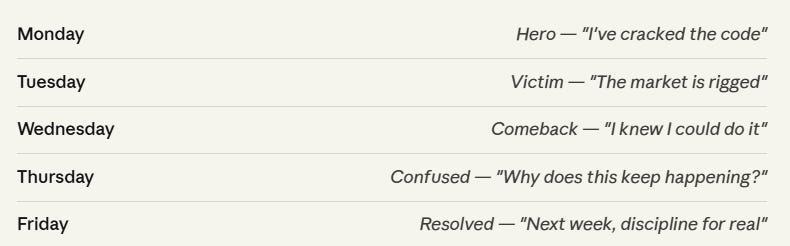
If that looks familiar, you’re not trading. You’re starring in a five-episode drama that airs every week and always ends the same way. The plot twist you need isn’t a better indicator — it’s a consistent behavioral system that doesn’t vary based on how yesterday went.
The One Line Worth Writing Down
“I don’t need to win today. I need to survive long enough to win consistently.”
Consistency doesn’t look like green every day. It doesn’t look like massive wins or perfect entries. It looks like small, controlled losses, measured profits, and zero emotional explosions. It looks boring from the outside. It looks like freedom from the inside.
Trade less. Think more. Protect your capital like it’s the oxygen keeping this whole endeavor alive — because it is.
— Soubhagya Sahoo
Founder, TSM Hub
P.S.
Everything above is easier to say than to do — alone. The traders who genuinely make this shift aren’t doing it in isolation; they’re doing it inside a community of people who are having the same honest conversations, catching each other’s blind spots, and building real systems together. At TSM Hub, that’s exactly what we’re building — a space where discipline isn’t just preached, it’s practiced collectively. Trading is hard. Doing it with the right people around you makes it a learnable craft instead of an endless struggle. Join us and let’s build toward actual financial freedom — through trading and investing, done the right way, together.